


Coxarthrosis of the hip joint is a chronic pathological process in which the integral structure of the joint tissue changes due to impaired metabolic processes.With coxarthrosis, what happens in the body?Coxarthrosis of the hip joint is characterized by processes of dystrophy and degeneration that affect people of the middle and elderly age group.
What are we talking about?
Arthrosis of the sacrococcygeal joint is characterized by a long course, and it is difficult to immediately diagnose coxarthrosis changes.What is coxarthrosis?Pathological processes, even based on the name of the pathology (coxarthrosis), initially affect the cartilage, and as this disease of the hip joints progresses, destructive changes affect the bone articulated structures.
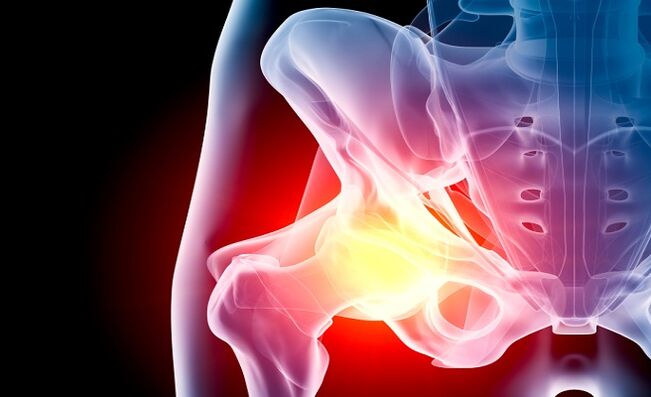
Osteoarthritis of the hip disrupts the function of the joints; when compared with other pathological processes, deforming osteoarthritis of the hip joint (also called coxarthrosis) is observed more often and, as a rule, appears after the age of forty.Diseases of the hip joint in women are less common than diseases of the hip joint in men.
About the reasons
With coxarthrosis, the causes are of different origins; the most common are:
- Impaired blood flow to the area of affected joint tissue.Due to various underlying causes, disruption of the vascular system appears, the outflow through the venous vessels is worsened, and blood flows poorly to the arterial vascular tissues.All these changes that occur during this disease lead to the accumulation of organic compounds characteristic of metabolism.Such enzymatic compounds have a destructive effect on cartilage tissue.
- Traumatization.The most common causes of coxarthrosis of the hip joint are long-term minor and invisible injuries that thin and damage cartilage tissue and form post-traumatic coxarthrosis.
- Dysplastic coxarthrosis of the hip joint can form due to excessive overload of the joints.Degeneration processes develop, joint tissue is deformed due to heavy physical work.
- The disease can manifest itself due to the patient's excess weight.The joints are overloaded, which causes inflammation, and in the future this threatens deformation.
- With a family history, deforming arthrosis of the hip joint also manifests itself.The disease itself does not pass along the hereditary line; specific properties and composition of cartilage and bone structures can be transmitted.Many circumstances with coxarthrosis of the hip joint, together with this cause, have a greater impact compared to other factors.
- Endocrine dysfunctions.Often changing concentrations of hormonal compounds affect metabolic processes, which leads to inflammatory changes in the joints and deforming coxarthrosis develops.
- A person does not like to exercise physical activity and is lazy, which is why he develops DOA of the hip joint and sacral osteochondrosis.
- Other pathological processes (necrotic changes in the femoral head, severe infectious pathologies).If unprofessional treatment measures were provided, then many pathologies will lead to the patient also developing deforming osteoarthritis of the hip joint as a complicated condition.
- Inherited pathological changes (dysplasia conditions, congenital dislocation of the hip) contribute to the development of DOA of the hip joint.
This is why this pathological process occurs.
About symptoms
The symptoms of coxarthrosis of the hip joint are characterized by slight differences at different stages of the formation of the pathological process.But there are signs of arthrosis of the hip joint, which determine the initial stage of coxoarthrosis.
If they are identified in a timely manner, the treatment of coxarthrosis will be more successful.
But often patients with an affected hip joint and symptoms of the disease come to the doctor in the late stages of developing signs of coxarthrosis, which greatly reduces the chance of successful treatment of coxarthrosis.
General symptoms include the following:
- Severe pain is the main symptom of hip disease.At the initial stage, pain manifests itself during physical activity of a person.As the destruction of the hip joint progresses, pain symptoms appear constantly, and the person also experiences aching pain in the sacrum.
- With arthrosis of the hip joint, other symptoms are expressed by the fact that the patient is limited in movements, he is constrained.In the initial stages of coxarthrosis, these symptoms can be observed after the patient awakens or after heavy physical work.
- The length of the lower limbs changes.When these symptoms are present, the hip joint has been affected for a long time, this is accompanied by deformation changes affecting the pelvic area.
- Atrophic changes are severe manifestations characteristic of this pathology.The initial stage is characterized by slight muscle weakness.
- The patient limps, he walks differently, which indicates deformation changes in the bone structures.
- There is a strong crunch in the joint tissues, which signals pathological changes.
About the degrees of pathology
Coxarthrosis has 4 degrees of development:
- The initial stage is characterized by a mild course of the pathological process.The patient does not suspect for a long time that he has coxarthrosis changes.Therefore, if coxarthrosis is not treated in a timely manner, the pathology will progress.At this stage of the pathology, the damaged joint tissue may periodically ache and ache after prolonged physical overload.The process can be one- or two-way.The patient may limp, the muscles are in hypertonicity, they resist deformation conditions.Soreness disappears the moment a person stops physically overworking, pain appears periodically.Osteochondrosis of the sacral region may sometimes worsen.An x-ray will show that the joint space is slightly narrowed.
- At the next stage of pathology progression, the articular tissue, gradually deteriorating, undergoes significant destructive changes.Symptoms intensify, painful sensations radiate to the hip area, and may be under the pubic symphysis or in the knee.In a patient with hip joint problems, osteochondrosis may also worsen.Soreness not only occurs after physical work, but is also observed in a calm state.If therapeutic measures are not carried out, the patient will develop a limping gait and the spine will be overloaded.Osteochondrosis symptoms manifest as pain and stiffness of the spinal column in the morning.Extensor and abductor femoral myofibers weaken.Sacral osteochondrosis is progressing.
- In the third degree of the pathological process, the cartilage tissue is almost completely destroyed.An x-ray will show a thread-like joint gap.The joint will be severely deformed.Sacral osteochondrosis will always be aggravated.The patient will not be able to do without painkillers.Without support from the cane, the patient will not be able to move.Edema and atrophic changes will occur in damaged articular tissue.
- In the last stage of pathology, coxarthrosis cannot be cured without surgical methods.The bone structures of the articular tissues of the hip area have completely fused, the pain is constant, severe swelling changes are observed, and osteochondrosis of the sacral region is also worsened.
About diagnostics
In order for treatment to be correct for osteochondrosis of the hip joint, you should consult a doctor who treats coxarthrosis of the hip joint.He will give an appointment to undergo diagnostic measures.Diagnosis of coxarthrosis consists of:
- After collecting medical history data, the medical history is filled out by the doctor, he takes into account all the symptoms.The presence or absence of burdened heredity and traumatic exposure is also clarified.The doctor examines the problem area and performs a series of functional tests.
- A general and biochemical blood test is performed.If the rate at which red blood cells settle is increased by more than 29-31 mm/h, then inflammation exists.Blood biochemistry will show marker indicators of the inflammatory process (C-reactive protein type, globulin, immunoglobulin compounds, seroglycoids).This study will help differentiate this pathology from other pathological processes.
- An X-ray examination is used, which will show osteophytic growths, how narrowed the joint gap is, how cartilage tissue ossifies, and the density of the bone structures located under the cartilaginous tissue.But soft tissue structures cannot be detected using x-rays.
- Computer and magnetic tomography examinations are used.Using these methods, you can see how affected the articular structures of a given area and nearby tissues are, and you can also find out the root causes that provoked the pathological process.
About treatment
How to treat coxarthrosis of the hip joint, which doctor treats coxarthrosis, how to treat it?When treating deforming arthrosis of the hip joint, medications or surgical methods are used.If the patient has arthrosis of the sacroiliac joints, treatment will be long-term, consist of several stages, symptoms and treatment are interdependent.
Effective treatment of osteoarthritis of the hip joint lies in the shortest possible period of treatment from the moment the diagnosis was established.If a patient has advanced coxarthrosis, treatment should be carried out by a doctor in the field of orthopedics.
But when the patient suspects that the hip joint has arthrosis, because after he ran 8-9 km and felt pain in the groin area, then in this case he should contact a specialist who treats rheumatic changes.Here's what kind of doctor treats arthrosis of the hip joint, and who treats these pathological processes.
About medications
For coxarthrosis of the hip joint, drug treatment is aimed at:
- Elimination of pain.
- Restoration of tissue trophism.
- Activation of regeneration processes.
- Improved blood flow.
- Reducing pressure on damaged areas.
- Increase in the size of the joint space.
How should hip joint types be treated to relieve pain?Treatment of arthrosis of the hip joint is carried out with medications:
- Non-steroidal drugs that relieve inflammation.They use injections and tablets.They relieve pain.
- Chondroprotective agents.They use injections.These medications provide nutrition to the affected tissue structures, they stop destructive processes, and the joint will function normally.
- Muscle relaxants.These remedies will relieve muscle spasms and improve microcirculatory processes.
- Medicinal ointments, creams, lotions.By applying this group of drugs externally, the painful area is stimulated, microcirculatory processes are improved, and spasm is relieved.
- In order to treat the hip joint, steroid injections are used.These injections relieve the aggravated condition and eliminate severe pain.
- Vasodilators are used.These medications expand vascular tissues, relax their smooth muscle fibers, improve blood circulation in the joint, and relieve spasms.
What other methods of treating coxarthrosis exist, how to treat it?Kinesio tapes are used.Kinesio taping has long been used in sports medicine.Tape is a special type of cotton, hypoallergenic and elastic plaster.If it is glued to the skin, then:
- Microcirculatory processes intensify, lymph flows out, and a drainage effect is created.
- Muscle function is normalized.
- Painful sensations decrease or disappear completely.
- The articular surface or ligament is carefully fixed.
Kinesio taping has the following advantages:
- The effect lasts as long as the application is applied.
- Efficiency increases with physical activity.
- Does not cause any discomfort.
- There are no drugs in the composition.
For the hip joint, how should it be treated and how to apply it?Hair will interfere with taping, so the skin is cleansed and disinfected.Take 4 tapes, the length of the strips is from 15 to 20 cm. They are applied to the patient in a lateral position so that the articular surface is on the upper side, and the lower limb should be bent at the knee.
The scheme is simple:
- The base of the tape (about 4 cm on both sides) is glued, but not stretched, the main section is stretched as much as possible.
- The first strip is applied in a vertical position so that the central zone of the tape is on the affected joint.
- Another strip is glued in a perpendicular position to the previous one, stretching it as much as possible.
- The next 2 tapes are applied diagonally, stretching as much as possible.
- After application, the tape is rubbed so that it sticks better.
Surgical methods are carried out at the extreme stage of the pathological process, when the joint is not functional.
The joint is usually replaced with prosthetics and the following manipulations are performed:
- The femoral head is cut off and a pin is inserted inside.A titanium analogue of the femoral head is attached to it.
- Sections of the pelvis are removed segmentally and a special polymer stock is attached to connect it to the artificial head.
If the operation was successful and the joint was properly used, then it can serve for about two decades.
About prevention
To prevent coxarthrosis of the hip joint, the root causes of the pathological process should be prevented and promptly eliminated.Prevention of coxarthrosis lies in the fact that the pathology should be diagnosed in a timely manner.To prevent coxarthrotic changes, the patient must:
- Swim.
- Perform physical therapy.
- Ski walking using poles.
- Sometimes to be treated in sanatoriums.
- Learn how to massage yourself.
- Use special massage techniques.
- Control body weight.
- Take chondroprotective agents regularly.
- Don't get too cold.
- Avoid injury.
- You should eat a balanced diet so that vitamins are present in the food in the required quantities, excluding foods that are too fatty, salty, or those containing many preservatives.You should eat lean fish, meat, dairy products, buckwheat, lentils, natural vegetables and fruits.Collagen protein is required, found in aspic, jellied fish, and fruit jelly.Sugar is replaced with honey.
If a person is physically active, then therapeutic measures will bring maximum results:
- The joint will function normally.
- Muscle tissue will be strengthened.
- Blood flow to the joint structures and the area around it will improve.
- Lower back pain will disappear.
- Complicated conditions will not arise.
It is worth remembering that timely diagnostic measures allow treatment to begin earlier, the progress of the pathology will stop.Complicated conditions will not arise.Therefore, it is better not to delay treatment, and if symptoms appear, it is better to immediately consult a doctor.